The 5-Minute Response Rule for WhatsApp
March 18, 2026

Picture this. A buyer fills out a form on your website at 11am on a Tuesday. They're looking at a 2BHK in Andheri, budget around ₹1.2 crore, ready to visit by the weekend.
Your agent sees the lead at 4pm. They send a WhatsApp message. No reply. They try again the next morning. The buyer sends back a polite "we've already finalised something with another broker."
Five hours cost you a deal. This is not an isolated story. This is the system failing — every single day.
Industry research consistently shows that responding to a lead within 5 minutes makes you 9x more likely to convert them. Wait an hour and 75% of those leads are already in conversation with someone else. In real estate — where the buyer is comparing three to five brokers simultaneously — this window is not five minutes. It might be closer to two.
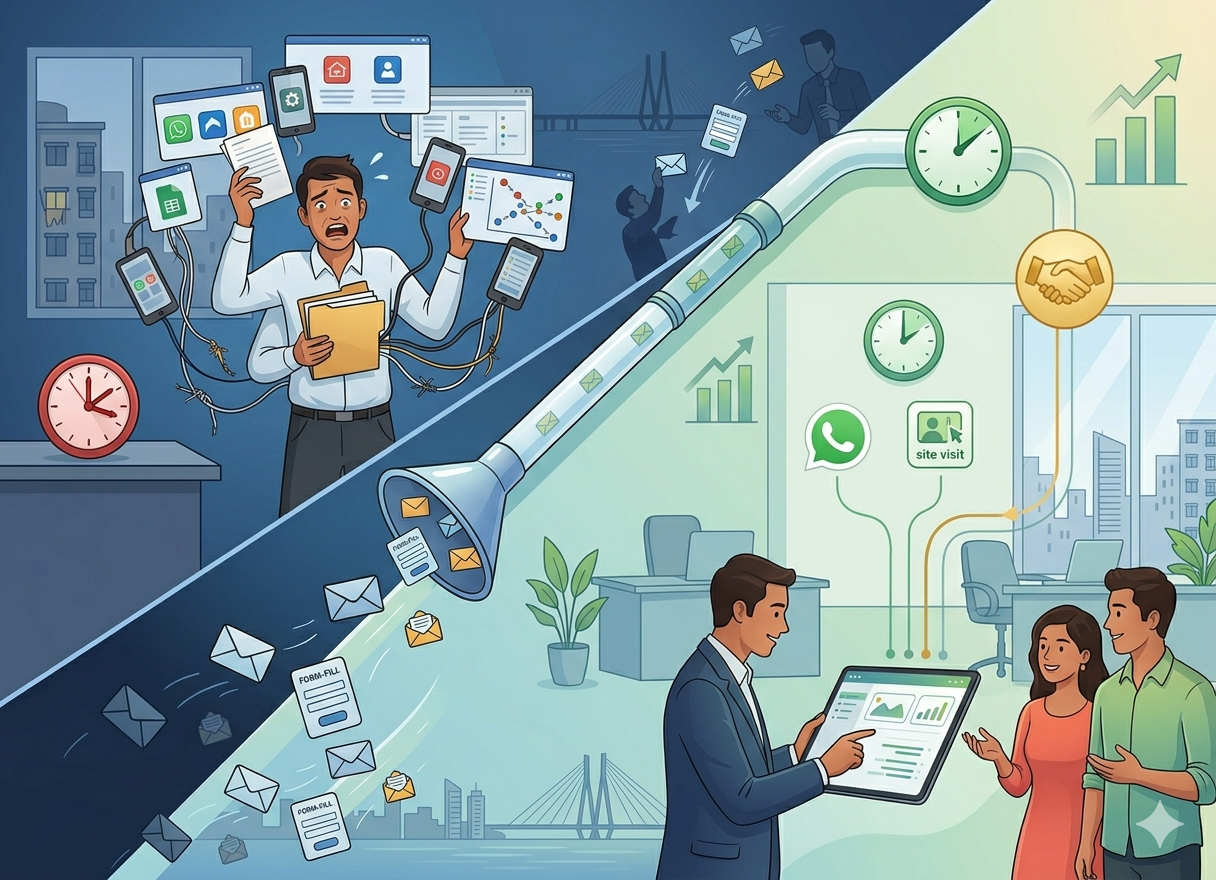
Most real estate firms in India are responding at an average of 4 to 6 hours. Not because the agents are lazy. Because the system is broken. A lead comes in through 99acres, another through MagicBricks, one more through an Instagram ad, and two through the website contact form. Each one lives in a different place. And somebody has to check all of them, manually, multiple times a day.
We tracked 30 days of inquiry data for one real estate firm. What we found:
The marketing was working. The website was decent. The agents were capable. The leads were coming in. And the money was walking out the door because the gap between form-fill and first call was measured in hours, not seconds.
The instinct is to hire another person to manage leads. But more people managing the same broken system just means more people doing the wrong thing faster. The problem is structural — and the solution is a system, not a salary.
Here is what changes when you connect the pieces properly:
Website form, WhatsApp message, 99acres inquiry, Instagram DM — all of it drops into a single lead pipeline the moment it arrives. No checking multiple apps. No lead slipping through a gap between platforms.
The lead gets a WhatsApp acknowledgment within seconds of submitting. An automated flow then collects budget, location preference, and timeline. By the time your agent picks up the phone, they already know exactly who they're calling and what that person wants. The conversation starts warmer because it didn't start cold.
Leads that go quiet for 48 hours get a check-in message. Site visits get a morning-of reminder — no-show rates drop significantly. Agents stop relying on memory to know who to follow up with today.
One dashboard. Every lead's status, source, and last touch — updated in real time. The Monday meeting stops being about "who talked to whom" and starts being about "which source is converting and where is the pipeline stuck."
For the firm we worked with, first-response time dropped from 6 hours to under 3 minutes. Not because they hired more people. Because every lead now gets an immediate response, automatically, regardless of what time it comes in or how busy the team is.
The agents — who were previously doing data-entry work manually — started spending their time on actual sales conversations. The work didn't increase. It changed shape.
Check your average lead response time. Pull the last 20 inquiries and calculate how long it took to send the first message. If the answer is more than 15 minutes for any of them, you have a system problem — and the longer you wait to fix it, the more it costs.
Every week you don't fix this, leads are walking away. Not to better brokers. To faster ones.

Mumbai-based web design, development, and business automation agency. We build connected growth systems for real estate firms, consulting practices, and service businesses. Learn more →
Your email address will not be published. Required fields are marked *

March 18, 2026

March 28, 2026
Comments
Vikram S.
March 12, 2026 at 10:22 am
"This describes our team exactly. We have leads coming from four different sources and nobody has a single view of what's happening. Going to look into the dashboard setup."
Lazy Management
March 12, 2026 at 11:45 am
"That fragmented multi-source problem is the most common thing we see. Happy to walk you through what a connected setup looks like — feel free to book a quick call."